
Medigap Plan G is quickly becoming one of the more common options when it comes to Medigap plans. And often, Plan G is among the best “deals” financially.
With Plan F ending for new Medicare enrollees in 2020, many beneficiaries are looking at Medigap Plan G as a comprehensive coverage alternative. Even before that announcement in 2015, Plan G had shown itself to be a winner in terms of premiums, rate stability over time, and comprehensive coverage. Now, in 2026, it is the most commonly selected plan by far.
The foremost thing to remember when it comes to Medigap plans is that the plans are Federally-standardized. This just means that all of the companies provide the exact same coverage plans. Coverage comes from the Medigap coverage chart. So while rates can, and do, vary considerably, the benefits are always the same when it comes to Medigap plans. Likewise, the plans also work the same way, can be used the same places and pay claims on the same time schedule and amounts. So when it comes to comparing Medigap plans, you should compare on price and company reputation.
What Does Medigap Plan G Cover?
Let’s take a look at what Medigap Plan G covers. It is one of the more comprehensive Medigap plans and covers everything that Medicare does not cover with the exception of the Medicare Part B deductible, which is currently $283/year (2026). This is the doctor’s office deductible. So, typically, 1-2 doctor visits knock out the deductible. Regardless of whether you meet the deductible or not, premium savings are often great enough to make the plan a better deal anyway (more about this later).
So what does Plan G cover: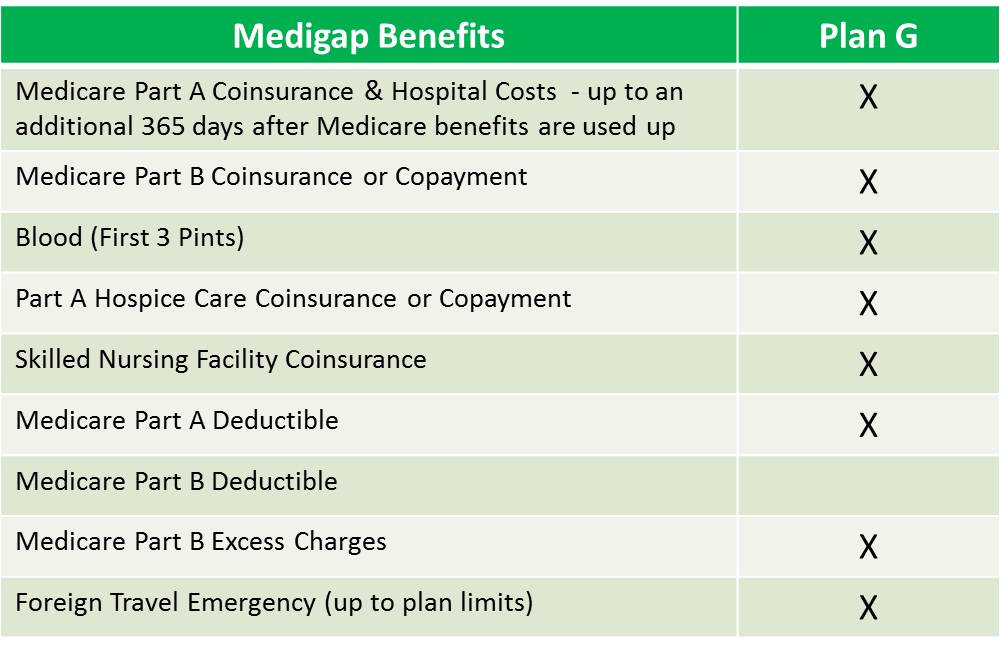
- Medicare Part A coinsurance and hospital costs (up to an additional 365 days after Medicare benefits are used)
- Medicare Part B coinsurance or copayment
- Blood (first 3 pints)
- Part A hospice care coinsurance or copayment
- Skilled nursing facility care coinsurance
- Part A deductible
- Part B Excess charges
- Foreign travel emergency
It is an easier exercise to talk about what Plan G does not cover. That one thing is the Medicare Part B deductible ($283/year for 2026). All other charges are covered by Medigap Plan G and that deductible amount is your maximum out of pocket costs for the year.
How Does Medigap Plan G Work?
Medigap Plan G is a Federally-standardized Medigap plan. As such, it works just like other Medigap plans. All Medigap plans, regardless of what your insurance company is, can be used at ANY doctor/hospital that takes Medicare nationwide. There are no networks to stay within or typical PPO/HMO concerns.
Additionally, the claims are all handled automatically through the Medicare “crossover” system. This is Medicare’s system to coordinate the payments from the secondary insurance provider (your Medigap plan). It insures that the policyholder does not have to be involved in the claims process. Medicare-approved claims are paid automatically by the Medigap plan. There’s not an approve/deny claims process – if Medicare pays, the Medigap pays. If Medicare does not, the Medigap plan does not.
Is Medigap Plan G the Best Deal?
In recent years, many companies have considerably lowered their rates on Plan G. While some initially thought this may have been a “buying business” tactic that would result in later large increases, this has not borne itself out to this point with most companies. Plan G rates are among the most stable of any of the plans. There are several significant reasons for this.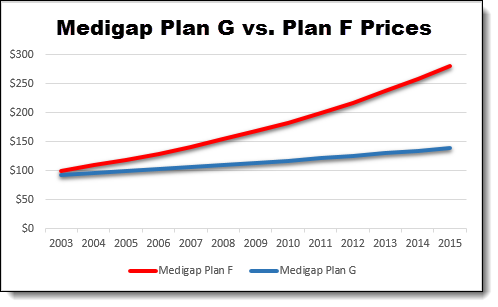
First of all, Plan G is not offered as a “guaranteed issue” (no health questions) option in situations where someone is losing group coverage or Medicare Advantage plan coverage. In those situations, applicants can get a handful of the Medigap plans (including Plans A, C and F) on a “guaranteed issue” basis. So someone with pre-existing conditions that was losing their group coverage, would be eligible for Plan F but NOT Plan G. Over time, this leads to the Medigap Plan G policyholder “pool” being, on average, healthier and having fewer claims. In turn, this leads to fewer/smaller rate increases on ‘G’ as compared to other plans including Plan F. This is not theory, but rather, has shown itself to be accurate over the last 10 years with Medigap Plan G average annual increases being approximately 2% lower than Plan F average annual increases.

The second big advantage of Medigap Plan G is that it is often a better deal than other options. In comparison to Plan F rates, Plan G rates are typically $400-700/year lower. The Part B deductible, which is the only difference in ‘F’ and ‘G’, is currently $283/year (2026). So you can potentially save a few hundred dollars with ‘G’ (and have a more rate-stable plan) by paying this deductible.
One thing to keep in mind when comparing plans is that insurance agents are financially incentivized for your premium to be a higher. Because they receive a percentage-based compensation, the higher your premium is, the more money they make. Likewise, insurance companies obviously prefer you to be in higher-premium plans because they make more money! What is a good deal for insurance agents and insurance companies is probably not a good deal for you.
Medigap Plan G vs. Plan N: What’s the Difference?
For many people, the Medicare Supplement decision eventually comes down to Plan G vs. Plan N. The two plans are very similar, but there are a few important differences that can make one a better financial fit than the other.
Both Plan G and Plan N provide extensive coverage for the gaps in Original Medicare. Both cover the Medicare Part A hospital deductible, hospital coinsurance, skilled nursing facility coinsurance and most Medicare Part B coinsurance. Both also allow you to use any doctor or hospital nationwide that accepts Original Medicare.
And importantly, neither Plan G nor Plan N pays the annual Medicare Part B deductible ($283 in 2026).
So the Part B deductible is not really a deciding factor when comparing Plan G and Plan N. You pay it under either plan.
The primary differences are the monthly premium, Plan N copays and Medicare Part B excess charges.
| Benefit or Cost | Plan G | Plan N |
|---|---|---|
| Medicare Part A deductible | Covered | Covered |
| Medicare Part B deductible | You pay it | You pay it |
| Part B coinsurance | Covered | Covered, subject to certain copays |
| Doctor office copays | None | Up to $20 for some visits |
| Emergency room copay | None | Up to $50 if not admitted |
| Part B excess charges | Covered | Not covered |
| Nationwide Medicare provider access | Yes | Yes |
| Typical monthly premium | Usually higher | Often lower |
Why Would Someone Choose Plan G?
The primary appeal of Plan G is predictability.
Once you have satisfied the annual Medicare Part B deductible, Plan G generally pays the remaining Medicare-approved Part A and Part B cost-sharing that the plan is designed to cover.
There are no Plan N-style office visit copays to keep track of, and Plan G also covers Medicare Part B excess charges.
For someone who visits doctors frequently, sees multiple specialists, or simply prefers knowing that most Medicare-approved medical expenses will be covered after the Part B deductible, the additional premium for Plan G may be worthwhile.
Plan G is especially appealing when its premium is only slightly higher than Plan N.
Why Would Someone Choose Plan N?
Plan N takes a slightly different approach.
In exchange for accepting some additional out-of-pocket responsibility, you can often obtain a lower monthly premium.
With Plan N, you may pay up to $20 for certain office visits and up to $50 for an emergency room visit that does not result in an inpatient admission. Plan N also does not cover Medicare Part B excess charges.
That does not necessarily make Plan N more expensive overall.
For example, suppose Plan N costs $30 per month less than Plan G.
That is:
$30 × 12 months = $360 per year in premium savings
You would then compare that $360 of guaranteed premium savings with the Plan N copays and other expenses you are likely to incur during the year.
Someone who rarely visits the doctor might pay relatively little in Plan N copays and keep most of those premium savings.
Someone who has numerous medical appointments could see more of the savings offset by copays.
That is why we generally recommend looking at the annual cost difference, rather than simply asking which plan provides more coverage.
What About Medicare Part B Excess Charges?
This is another difference that sometimes causes confusion.
Plan G covers Medicare Part B excess charges. Plan N does not.
An excess charge can occur when a physician accepts Medicare patients but does not accept Medicare “assignment.” In those situations, the provider may be permitted to charge more than the Medicare-approved amount.
If your physicians accept Medicare assignment, there is no excess charge.
For most people considering Plan N, it is worth asking their regular physicians whether they accept Medicare assignment rather than automatically eliminating Plan N because of the excess-charge provision.
You can learn considerably more about these differences in our complete Medigap Plan N guide, including how Plan N copays work and how to evaluate the risk of Part B excess charges.
So, Is Plan G or Plan N the Better Value?
There is no single answer for everyone.
The most useful comparison is:
Annual Plan G premium − Annual Plan N premium = Plan N’s annual premium savings
Then compare those savings with the additional expenses you could reasonably expect under Plan N.
If Plan G is only modestly more expensive, you may decide that its more complete coverage and predictable costs justify the higher premium.
If Plan N is substantially less expensive, accepting occasional copays may produce meaningful long-term savings.
The answer can also vary significantly by ZIP code, age, gender and insurance company because Medigap premiums are not standardized even though the medical benefits are.
That is why it is important to compare actual Plan G and Plan N premiums available where you live rather than choosing a plan based only on its benefit letter.
Want to see the difference for yourself? Request Medigap quotes from 65Medicare.org and we can compare Plan G and Plan N rates from the companies available in your area. Quotes will be sent directly by email with no phone number needed.
Where Can I Use a Medigap Plan G?
Medigap Plan G is just like other Medigap plans – it can be used at any doctor or hospital that takes Medicare. This is true, regardless of which insurance company insures you under their Plan G – whether it is a “name brand” company or a smaller, more local insurer. When a doctor agrees to take Medicare, he or she is also agreeing to take any of the standardized Medigap plans.
One of the biggest advantages of the Medigap plans is their portability. These plans can be used across state lines and are accepted anywhere in the country that takes Medicare. This is one of the biggest differentiators of Medigap and Medicare Advantage. Advantage plans are network-based plans and are based on your county of residence. If you are traveling with that type of plan, you would be out of network in most cases, causing you to have larger out of pocket costs. By contrast, Medigap Plan G can be used anywhere nationwide that accepts Medicare.
What Companies Sell Medigap Plan G?

In recent years, with the growth in popularity of Medigap Plan G, more and more companies have begun to offer this plan. Then, with the recent announcement of the 2020 elimination of Plan F, Plan G is now be the most comprehensive plan offered (after 2020).
All of this has led to a very competitive marketplace for Plan G in most locations. For example, a survey of the marketplace in ten different states shows that there are 8 or more insurance companies within $10/month premium of the lowest Medigap Plan G premium (September 2026 rates).
Some of the larger companies that are competitively priced in many markets include Aetna, CIGNA, Mutual of Omaha, United Healthcare, and Chubb/INA. But aside from those larger, more well-known companies, there are also other lesser-known companies that offer Plan G (keep in mind that benefits, coverage, and the way plans work are all identical with all Plan G’s), including companies such as Bankers Fidelity, ACE, Medico, New Era, Manhattan Life, and others.
Many beneficiaries start by comparing all available Medigap plans before deciding whether Plan G is the best fit. As always, when comparing Medigap plans, it is crucial to get a full comparison of Medigap Plan G rates for your area when you are choosing a plan. You should target the companies that are both competitively priced and highly rated when picking a Plan G. It is both unwise and unnecessary to pay “extra” for the same thing.
When Can I Sign Up for a Medigap Plan G?
The very best time to enroll in any Medigap plan, including Plan G, is during your initial open enrollment period. This period starts on the 1st day that you are both age 65 or older and enrolled in Medicare Part B. The “open enrollment” period lasts for 6 months.
Note that there is an annual election period that runs October 15-December 7 each year. Many Medicare beneficiaries, insurance agents and advertisers mistakenly call the “open enrollment” period. This period has nothing to do with Medigap Plan G or other Medigap plans – it is only for Part D prescription drug coverage and Medicare replacement plans like Medicare Advantage.
So, the best time to sign up for Medigap Plan G is when you turn 65 or start Medicare Part B for the first time. After that, you can enroll in a Medigap plan or change Medigap plans at ANY time. However, this does require, in most states, answering some medical questions and getting “approved”. So it is wise to do it when you are first eligible.
There are some situations that are considered “guaranteed issue” situations, during which you do not have to answer medical questions to enroll in a Medigap plan. Some of these situations include losing group coverage or losing Advantage plan coverage due to a move. During those “guaranteed issue” times, you can get some plans on a “guaranteed issue” basis. But as discussed above, the plans available on “guaranteed issue” do not include Plan G.
If you want more information about Medigap Plan G or a list of companies and rates for your area, please feel free to contact us for Medigap Plan G quotes or call us at 877.506.3378.

