

Medigap Plan N: Guide to Coverage, Costs, Copays and Plan G Comparison
Medigap Plan N — also called Medicare Supplement Plan N — has become one of the primary alternatives to Plan G for people who want comprehensive Medicare Supplement coverage but are willing to accept a little more out-of-pocket cost in exchange for a potentially lower monthly premium.
The basic idea behind Plan N is simple:
You keep Original Medicare, retain nationwide access to doctors and hospitals that accept Medicare, and receive protection against most of the major gaps in Medicare — while agreeing to pay certain office and emergency-room copays and any applicable Medicare Part B excess charges.
For many people turning 65, the Medigap decision eventually comes down to Plan G vs. Plan N. Plan G provides more predictable out-of-pocket costs. Plan N shifts a small amount of additional cost back to you in exchange for what is often a lower premium.
Neither plan is automatically better for everyone. The important question is whether the premium savings available with Plan N in your ZIP code are sufficient to justify the additional cost-sharing.
This guide explains exactly how Medicare Supplement Plan N works, what it covers, what it does not cover, how the copays work, what Medicare excess charges are, and how to determine whether Plan N or Plan G makes more sense for you.
If you are still getting familiar with Medicare Supplements in general, you may want to start with our Medigap Plans Guide, which explains how all of the standardized Medigap options work. Medigap Plans Guide
Want to skip ahead and compare actual prices?
Plan N premiums can vary significantly by location and insurance company even though the medical benefits are standardized. You can request current Medigap quotes by email from 65Medicare.org. We don’t do outbound calls, so no phone number needed. Get Medigap Quotes by Email
Plan N at a Glance
Here is the short version of how Medicare Supplement Plan N works:
| Plan N feature | How it works |
|---|---|
| Medicare Part A hospital deductible | Covered |
| Part A hospital coinsurance | Covered |
| Skilled nursing facility coinsurance | Covered |
| Part B coinsurance | Covered, subject to certain office/ER copays |
| Annual Medicare Part B deductible | You pay it |
| Office visit copay | Up to $20 for some office visits |
| Emergency room copay | Up to $50 if the visit does not result in inpatient admission |
| Part B excess charges | Not covered |
| Foreign travel emergency benefit | 80% subject to plan rules and limits |
| Prescription drugs | Not included |
| Provider network | No Medigap network — use providers that accept Original Medicare |
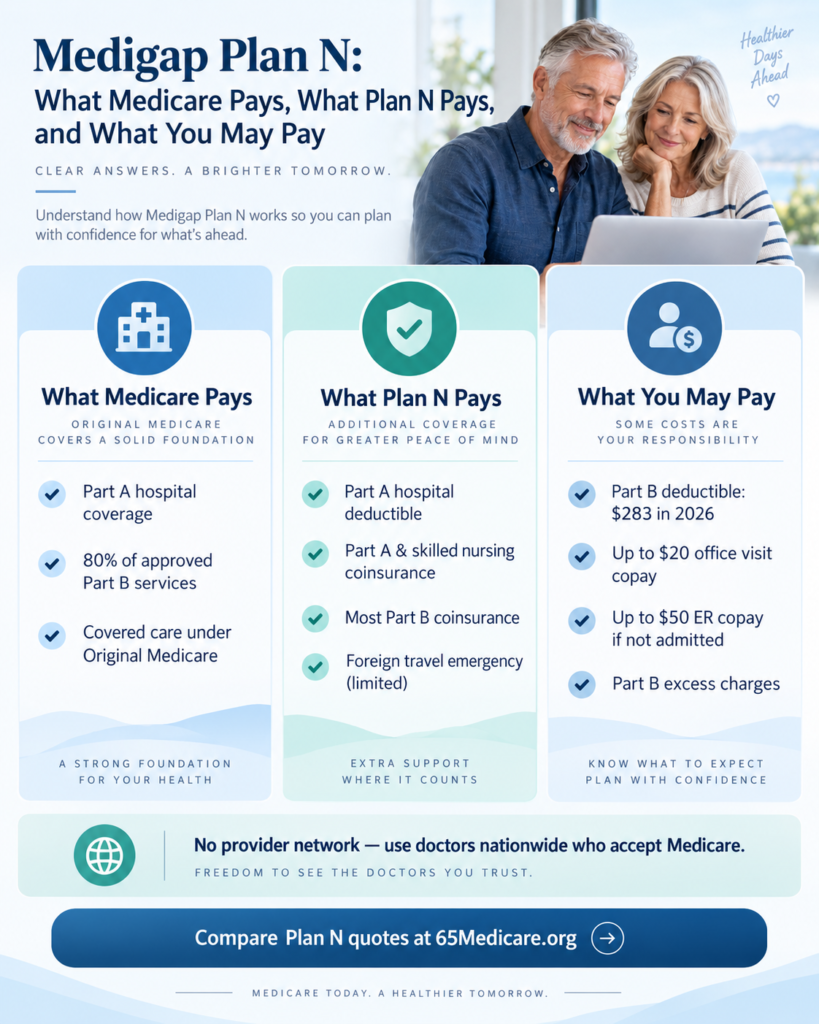
Medicare confirms that Plan N pays the Part B coinsurance but permits copayments of up to $20 for some office visits and up to $50 for emergency-room visits when you aren’t admitted as an inpatient. Plan N does not cover the Medicare Part B deductible or Part B excess charges.
For a side-by-side view of all standardized Medicare Supplement plans, see our Medigap Coverage Chart. Medigap Coverage Chart
What Does Medigap Plan N Cover?
Plan N covers most of the significant gaps in Original Medicare.
Among its benefits are the Medicare Part A hospital coinsurance and hospital costs for up to an additional 365 days after Medicare benefits are exhausted, the Medicare Part A deductible, skilled nursing facility coinsurance, Part A hospice coinsurance or copayments, the first three pints of blood, most Medicare Part B coinsurance, and limited foreign-travel emergency coverage.
That makes Plan N considerably more comprehensive than simply having Original Medicare by itself.
One important reason people purchase Medigap coverage is that Original Medicare does not have a built-in annual maximum out-of-pocket limit for Part A and Part B expenses. A Medicare Supplement plan takes on much of that exposure.
Plan N does not eliminate every possible bill, however. Understanding the expenses it leaves to you is the key to deciding whether it is the right plan.
What Does Plan N NOT Cover?
There are three Plan N expenses that deserve the most attention:
1. The Medicare Part B deductible
Plan N does not pay the annual Medicare Part B deductible. In 2026, that deductible is $283. It generally must be satisfied before Medicare begins paying for Part B-covered services.
It is worth pointing out that Plan G does not cover the Part B deductible either. Therefore, when you compare Plan G and Plan N, the Part B deductible does not usually affect the financial comparison between the two plans — you would pay it under either one.
That is an important distinction because the real financial differences between Plan G and Plan N are the premium, Plan N copays, and potential Part B excess charges.
2. Certain office and emergency-room copays
After the Part B deductible has been met, Plan N generally covers your Part B coinsurance. However, you can be responsible for a copayment of up to $20 for some office visits.
You can also pay up to $50 for an emergency-room visit that does not result in an inpatient hospital admission.
Notice the wording “up to.” It should not be interpreted as an automatic $20 charge every time you interact with a physician.
3. Medicare Part B excess charges
Plan N does not pay Medicare Part B excess charges.
This sounds alarming when it is first explained, but it is easier to understand once you know how Medicare assignment works.
What Are Part B Excess Charges on Plan N?
Medicare establishes an approved amount for covered Part B services.
A provider who accepts Medicare assignment agrees to accept Medicare’s approved amount as payment in full for the covered service. In that situation, there is no Part B excess charge.
Some Medicare providers may accept Medicare patients but not accept assignment. Where permitted, those providers may charge more than the Medicare-approved amount, subject to Medicare’s limiting-charge rules. The amount over Medicare’s approved amount is called an excess charge.
Plan G covers Part B excess charges. Plan N does not.
This makes the distinction between “accepting Medicare” and “accepting Medicare assignment” particularly important for Plan N policyholders.
Before choosing Plan N, you can ask physicians you see regularly:
“Do you accept Medicare assignment?”
If the answer is yes, Part B excess charges from that provider should not be an issue. In general, not accepting Medicare assignment is very rare and occurs with around 2% of providers nationally.
For a deeper explanation, read our guide to Medicare Part B Excess Charges. What Are Medicare Part B Excess Charges?
Does Plan N Have a Doctor Network?
No traditional Medigap Plan N policy has an HMO- or PPO-style provider network.
Original Medicare remains your primary insurance. Your Medicare Supplement follows Medicare and pays its portion of eligible claims according to the benefits of Plan N.
This means your primary concern is whether the provider accepts Original Medicare, not which insurance company happens to be printed on your Plan N insurance card.
This is one of the major differences between Medigap and many Medicare Advantage plans.
For someone who travels frequently, spends part of the year in another state, or simply does not want to select health care providers based on a private insurance company’s local network, this can be a significant advantage.
Read more in our guide: Do All Doctors Accept Medigap Plans? Do All Doctors Accept Medigap Plans?
How Does a Plan N Claim Actually Work?
One of the appealing aspects of Medicare Supplement coverage is that the claims process is generally very simple for the insured.
Suppose you have Plan N and visit a physician for a Medicare-covered service.
The physician submits the claim to Medicare first. Medicare processes the claim and pays its portion according to Medicare rules. Claim information is generally transmitted electronically to the Medicare Supplement insurer through the Medicare crossover process.
Your Plan N insurer then pays whatever Plan N owes.
If you owe a deductible, applicable Plan N copay, excess charge, or non-covered expense, you are responsible for that portion.
In other words, you generally do not submit one claim to Medicare and then manually send another claim to the Medigap company.
For more detail on the process, see How Medicare and Medigap Work Together. How Medicare and Medigap Work Together
Plan G vs. Plan N: What’s the Difference?
This is probably the most important comparison on this page.
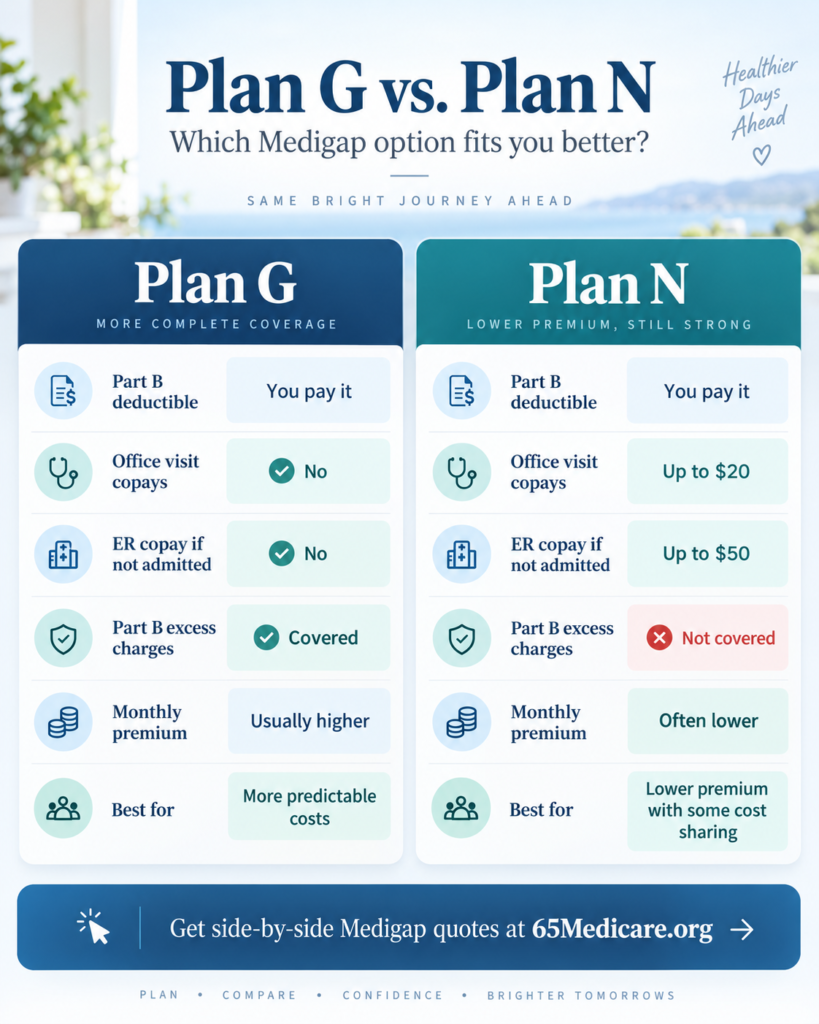
Plan G and Plan N are extremely similar. Both provide substantial protection against the gaps in Original Medicare. Neither covers your annual Part B deductible.
The key differences are these:
| Feature | Plan G | Plan N |
|---|---|---|
| Part A deductible | Covered | Covered |
| Part B deductible | Not covered | Not covered |
| Part B coinsurance | Covered | Covered, subject to Plan N copays |
| Office visit copays | No | Up to $20 for some visits |
| ER copay | No | Up to $50 if not admitted |
| Part B excess charges | Covered | Not covered |
| Provider network | None | None |
| Nationwide use with Medicare providers | Yes | Yes |
| Typical premium | Usually higher | Often lower |
The major financial question is therefore not:
“Which plan has better benefits?”
Plan G clearly provides somewhat more coverage.
The more useful question is:
“How much additional premium would I pay for Plan G, and is that additional premium worth eliminating the Plan N copays and excess-charge exposure?”
Our complete Medigap Plan G guide explains Plan G in greater detail. Medigap Plan G Guide
A Better Way to Calculate Plan G vs. Plan N
Here is a simple method we use when comparing the two.
First calculate:
Annual Plan G premium − Annual Plan N premium = annual premium savings with Plan N
Then compare those savings against the Plan N expenses you reasonably expect:
Possible office copays + possible ER copays + realistic excess-charge exposure
You do not need to add the Medicare Part B deductible to the Plan N side of this comparison because Plan G does not cover that deductible either.
Hypothetical example
Suppose Plan G costs $150/month and Plan N costs $120/month.
That means:
Plan G: $1,800/year
Plan N: $1,440/year
Plan N premium savings: $360/year
Now suppose you incur six $20 Plan N office copays during the year.
Your maximum assumed office copays in this simplified example would be $120.
You would still be $240 ahead on premiums and office copays under Plan N, assuming there were no ER copays or excess charges.
But change the rates to $140 for Plan G and $130 for Plan N, and the answer looks very different.
The annual Plan N premium savings would be only $120. In that situation, giving up the additional protections of Plan G may not look nearly as attractive.
That is why choosing Plan N without first seeing the actual Plan G and Plan N prices in your ZIP code does not make much sense.
Compare Plan G and Plan N rates side by side.
We can send current Medigap premiums and company information to you by email so you can see the actual price difference where you live. Request Medigap Quotes by Email
How Much Does Medicare Supplement Plan N Cost?
There is no single national Plan N price.
Even though the benefits of Plan N are standardized, insurance companies set their own premiums.
Pricing can be affected by factors such as your state and ZIP code, age, gender where permitted, tobacco status, the insurer’s pricing method, and available household discounts.
Two insurance companies can therefore sell essentially the same standardized Plan N benefits at substantially different prices.
This is one of the most misunderstood aspects of Medicare Supplement insurance.
Consumers sometimes assume a higher-priced insurance company must provide better Plan N coverage. That is generally not how standardized Medigap works.
Once you have decided you want Plan N, company selection should focus on factors such as premium, household discounts, historical pricing, financial stability, company experience, and your state’s particular Medigap rules — not the assumption that one company’s Plan N pays more medical benefits than another.
There are exceptions to the standard lettered-plan structure in Massachusetts, Minnesota and Wisconsin, which standardize Medigap differently.
Our broader guide explains how to choose a Medigap plan and insurance company. How to Choose a Medigap Plan
Is Plan N Only for Healthy People?
Not necessarily.
It is common to hear Plan N described as the plan for “healthy people who don’t go to the doctor very often.”
That is an oversimplification.
Frequency of doctor visits certainly affects the calculation because additional visits can create additional copays. But a person who sees multiple doctors could still come out ahead on Plan N if the premium difference between Plan N and Plan G is large enough.
Likewise, someone who rarely sees a doctor should not automatically select Plan N if the premium difference between N and G is only a few dollars per month.
The better decision is based on math and personal preferences, not just health status.
Plan N tends to be especially attractive to someone who values a lower fixed monthly premium, is comfortable receiving occasional medical bills, understands Medicare assignment and excess charges, and finds that Plan N is meaningfully less expensive than Plan G in his or her area.
Plan G can be more appealing to someone who places a high value on predictable expenses, doesn’t want to think about office-visit copays or excess charges, or finds only a small premium difference between G and N.
Does Plan N Cover Foreign Travel?
Plan N includes a limited foreign-travel emergency benefit.
For qualifying emergency medical care received outside the United States, applicable Medigap plans including Plan N generally pay 80% of certain medically necessary emergency charges after a $250 annual deductible.
The emergency must generally begin during the first 60 days of the foreign trip, and the benefit has a $50,000 lifetime limit.
This should not be confused with comprehensive international health or travel insurance. Someone taking an expensive or extended international trip may still want to evaluate separate travel medical coverage.
What Isn’t Covered by Plan N or Other Medigap Plans?
A Medicare Supplement is designed primarily to supplement Original Medicare. It is not intended to cover every health-related expense.
Medigap policies generally do not cover routine dental care, routine vision care, eyeglasses, hearing aids, long-term custodial care or private-duty nursing. Modern Medigap policies also do not include outpatient prescription drug coverage.
If you choose Original Medicare plus Plan N, you will typically want separate Medicare Part D prescription coverage unless you have other creditable drug coverage.
When Is the Best Time to Buy Plan N?
For most people, the easiest time to purchase Medicare Supplement Plan N is during their six-month Medigap Open Enrollment Period.
Under federal law, this six-month period begins the first month you are both at least 65 and enrolled in Medicare Part B.
During this period, an insurer cannot refuse to sell you a Medigap policy it offers because of your health or use medical underwriting to deny your application because of a pre-existing medical condition.
This is completely different from the October 15–December 7 Medicare Annual Enrollment Period.
The fall Medicare enrollment period does not create a nationwide annual Medigap open enrollment period.
After your initial Medigap enrollment window, federal law does not guarantee that you can simply switch Medigap policies whenever you want. Guaranteed-issue rights apply in certain situations, and some states provide additional switching protections or enrollment opportunities. Outside those protections, medical underwriting may apply.
That is why your initial Plan G versus Plan N decision should be made with a long-term view rather than just asking which policy is cheapest today.
For a full explanation, read When Is Medicare Supplement Open Enrollment? Medicare Supplement Open Enrollment Guide
Can I Switch From Plan N to Plan G Later?
Possibly — but you should not assume you will always be able to do it without underwriting.
If you are still within your Medigap Open Enrollment Period, have a federal guaranteed-issue right, or live in a state that provides an additional switching right, you may have protections that make changing policies easier.
In other situations, the new insurance company may be permitted to ask medical questions and decide whether to approve your application.
That creates an important long-term consideration.
Someone might initially choose Plan N because he or she is healthy, save money for several years, and later decide Plan G would be preferable. Depending on the person’s state, health and circumstances at that time, making that switch may not be as easy as it was at age 65.
State-specific rules matter considerably here.
Plan N vs. Medicare Advantage
Plan N is Medicare Supplement insurance. It should not be confused with a Medicare Advantage plan.
With Plan N, you remain enrolled in Original Medicare. Medicare remains your primary insurance and Plan N supplements it.
Medicare Advantage is a different method of receiving your Medicare benefits through a private Medicare plan and can involve plan-specific provider networks, copays, prior-authorization requirements and annual plan changes.
The differences go well beyond premiums.
If you are still deciding which Medicare structure you want rather than merely deciding between Plan G and Plan N, read our detailed Medigap vs. Medicare Advantage comparison before selecting a Medicare Supplement. Medigap vs. Medicare Advantage
Our 2026 Medicare cost study also looks at how premiums and out-of-pocket costs interact under the different Medicare options. The Real Costs of Medicare Choices
How to Compare Plan N Insurance Companies
Once you’ve decided that Plan N is the coverage level you want, the next decision is the insurance company.
Because standardized Plan N medical benefits are substantially the same from one insurer to another in most states, comparing companies is very different from comparing normal health insurance.
You aren’t looking for the company with a better cardiologist network or a lower specialist copay.
There is no separate Plan N physician network.
Instead, compare the actual premium in your ZIP code, available household discounts, rate history, financial strength, reputation, and other state- and carrier-specific factors.
This is also why getting only one Plan N quote tells you very little.
You want to know how that rate compares with the other companies selling the same standardized coverage in your area.
Who Should Consider Medicare Supplement Plan N?
Plan N is worth serious consideration when the premium savings compared with Plan G are meaningful and you are comfortable taking on several clearly defined expenses.
It may be particularly appealing if you want Original Medicare’s provider flexibility, expect to keep some money in your pocket each month through a lower premium, don’t mind occasional copays, and understand how to check whether providers accept Medicare assignment.
Plan G deserves a close look when the premium difference is relatively small or your highest priority is simplifying your medical expenses as much as possible.
And for people who are primarily concerned with obtaining the lowest Medigap premium and are comfortable taking substantially more out-of-pocket risk, High-Deductible Plan G represents another option worth understanding. High-Deductible Plan G Guide
The key is to compare all three based on actual prices where you live, rather than deciding based only on general statements about which plan is “best.”
Frequently Asked Questions About Medigap Plan N
Is Medicare Plan N the same thing as Medicare Supplement Plan N?
Yes. People frequently use “Medicare Plan N,” “Medigap Plan N” and “Medicare Supplement Plan N” interchangeably. The more precise terms are Medigap Plan N or Medicare Supplement Plan N.
Does Plan N cover the Medicare Part B deductible?
No. You pay the annual Medicare Part B deductible. The deductible is $283 in 2026. Plan G does not cover this deductible either.
Does Plan N have a $20 copay every time I see a doctor?
Not necessarily. Medicare describes the Plan N benefit as covering Part B coinsurance while allowing a copayment of up to $20 for some office visits.
What is the Plan N emergency-room copay?
Plan N can require a copayment of up to $50 for an emergency-room visit that does not result in an inpatient hospital admission.
Does Plan N cover excess charges?
No. Plan N does not cover Medicare Part B excess charges. A provider who accepts Medicare assignment will not charge a Part B excess charge.
Can I use Plan N in another state?
Traditional Plan N does not use a local HMO or PPO network. Because Original Medicare remains primary, you can generally use your coverage with providers throughout the United States that accept Medicare.
Does Plan N include prescription drug coverage?
No. Modern Medicare Supplement policies do not include prescription drug coverage. If you need drug coverage, you generally obtain it through a separate Medicare Part D plan.
Is Plan N cheaper than Plan G?
Plan N is often priced lower than Plan G, but there is no universal dollar or percentage difference. Rates vary considerably based on location, company and applicant characteristics. Compare the actual Plan N and Plan G rates available to you before deciding.
Is Plan N better than Plan G?
Neither is universally better. Plan G gives you greater cost predictability. Plan N allows some additional cost-sharing and may provide premium savings. The size of the actual premium difference is critical to the decision.
The Bottom Line on Medigap Plan N
Medicare Supplement Plan N occupies a useful middle ground in the Medigap market.
It provides substantial protection against Original Medicare’s out-of-pocket expenses while allowing the beneficiary to take responsibility for several specific costs: the Part B deductible, certain office and emergency-room copays, and any Part B excess charges.
The most important comparison for most Plan N shoppers is Plan N versus Plan G.
Because both plans require you to pay the Part B deductible, the decision primarily comes down to whether Plan N’s lower premium is enough to compensate you for accepting its copays and excess-charge exposure.
Sometimes the difference is substantial.
Sometimes it is surprisingly small.
There is no way to know which situation applies to you without comparing the actual rates available in your area.
Compare Plan N and Plan G Quotes
65Medicare.org can send you current Medigap options from multiple insurance companies by email so you can compare Plan N and Plan G premiums side by side. No aggressive sales calls, no obligation and no need to choose a plan before you understand your options.
65Medicare.org is a leading, independent Medicare insurance agency for people turning 65 and going on Medicare, as well as those comparing Medigap options later. You can get Medigap quotes by email or, if you have questions about this information, contact us online or call us at 877.506.3378.
*Reviewed by a licensed Medicare insurance agent / Last updated September 2026*
Sources: Medicare.gov, SSA

